
To provide innovative financial and industrial asset solutions to continue facilitating the transition from a linear to a circular economy, while aiming for increased monetization and decreased environmental impact.
Asset Conversion with Purpose
OUR MISSION IS CLEAR
The HG ESG Program Centers on
Three Main Drivers
Heritage Global Inc. and its subsidiaries firmly uphold the highest standards of integrity and ethical behavior in their dealings with employees, clients, buyers, suppliers, shareholders and the public. In 2022, we collaborated with an independent third-party firm to perform a comprehensive Environmental, Social and Governance (ESG) Materiality Assessment of our operations. As part of this assessment, our most pivotal ESG topics were identified as corporate governance, our role in the circular economy, and our commitment to supporting local communities.
Running a Responsible Business
Enabling the Circular Economy
Supporting Communities
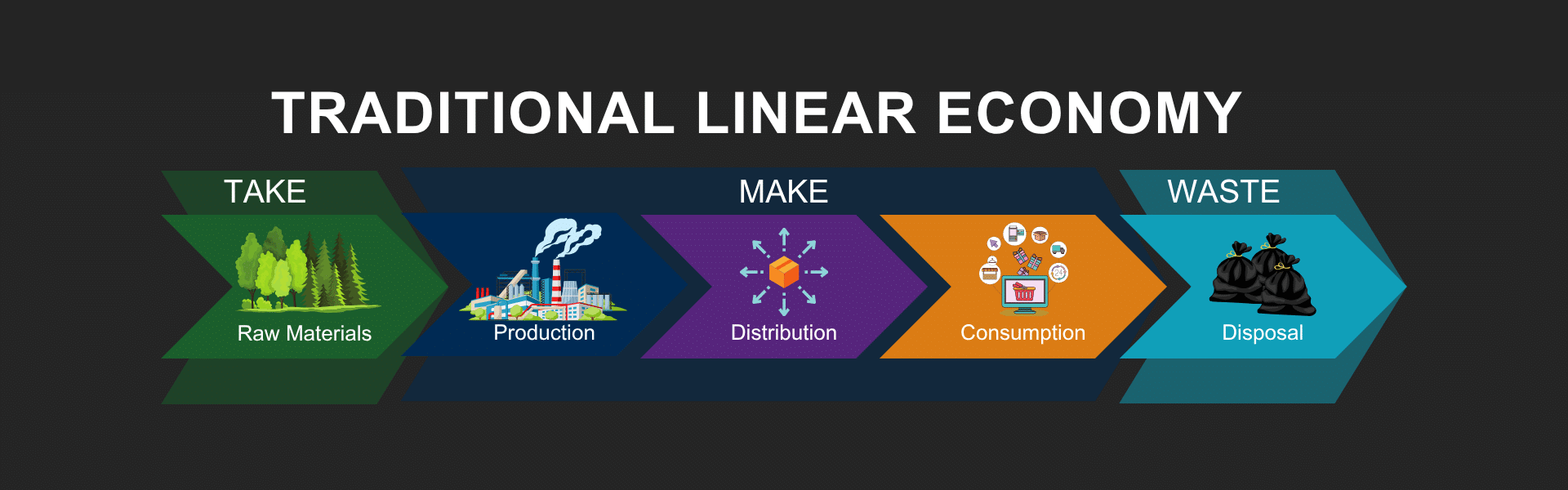
Traditional “Linear Economy” has a one-way flow of resources from production to consumption, lacking any form of cyclical reuse or regeneration.
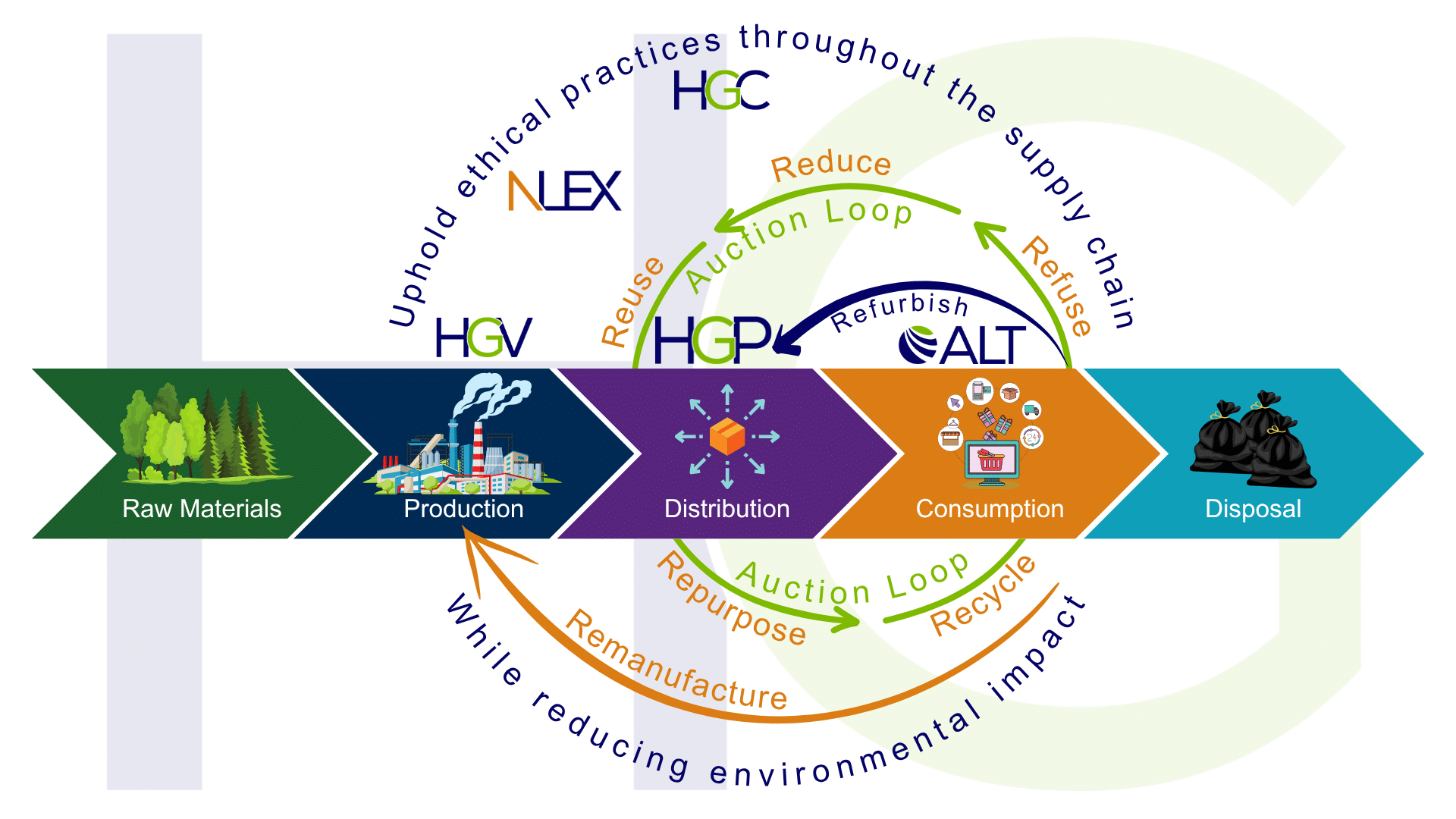
HG has been extending the life of second-hand assets since long before sustainability became mainstream. Our “Circular Economy” approach supports the repair, refurbishment, resale, reuse, repurposing and recycling of assets, helping keep usable equipment in circulation and out of landfills. Together with ethical practices across our supply chain, these efforts help reduce environmental impact and support sustainability throughout the asset lifecycle.
Sustained Environmental Impact: Tracking Our Progress
From 2021 to 2025, we helped avoid 150,915 metric tons of greenhouse gas emissions, equivalent to recycling approximately 53,327 tons of waste instead of landfilling it. On average, the assets evaluated for ESG purposes account for approximately 25% of the total assets sold through HGP and ALT.
Equivalencies based on EPA.gov
150,915
Metric Tons CO₂e Avoided
equivalent to GHG emissions avoided by
7,618
Garbage Trucks of Waste
recycled instead of landfilled
53,327
Tons of Waste
recycled instead of landfilled
12,828,778
Trash Bags of Waste
recycled instead of landfilled
Our Impact

Clients
Clients benefit from HG’s Industrial and Financial Asset divisions, which draw on over 200 years of collective industry experience and extensive transaction data. We leverage proprietary data and market knowledge to provide tailored solutions designed to deliver measurable outcomes. For organizations managing surplus or end-of-life assets, effective disposition can help recover value that might otherwise be lost. Our team is committed to transparency and data security throughout each project, helping clients manage assets responsibly and efficiently.

Buyers
For years, HG has been a go-to source for buyers seeking access to a wide range of specialized industrial and financial assets in an effective, often cost-efficient manner. Buying secondhand can provide cost savings and shorten lead and delivery times. Holding auctions for global corporations can also give buyers opportunities to source assets closer to their operations, potentially reducing transportation distances and associated logistics impacts. Additionally, debt buyers receive opportunities to bid on distressed asset portfolios from financial institutions and creditors. Our extensive expertise and dedication to excellence help us provide solutions that meet our buyers’ needs.

Planet
The implementation of a reverse supply chain can offer numerous environmental benefits. By extending the useful life of existing resources, businesses can reduce demand for newly manufactured replacement assets and help keep usable equipment out of landfills. Effective asset disposition processes, including the resale, refurbishment, repurposing and recycling of excess, obsolete and surplus assets, can help reduce waste. Transparency and responsible supply chain practices support these efforts and contribute to both short- and long-term sustainability objectives.
In 2024, we updated our GHG emissions calculations for the years 2021, 2022, and 2023 to reflect a Spend-Based Emissions Factors Approach. This method applies conservatively estimated emissions factors to asset sales values, enhancing the consistency, transparency, and stakeholder understanding of our environmental impact. Previously, we used a Detailed Emissions Calculation Process. Waste equivalencies are based on the U.S. EPA Greenhouse Gas Equivalencies Calculator, which uses EPA’s Waste Reduction Model (WARM) to estimate greenhouse gas emissions avoided by recycling mixed recyclables instead of landfilling them. At the time of the July 2024 update, EPA used an emissions factor of 2.88 metric tons CO₂e per short ton of waste recycled instead of landfilled. Current equivalencies shown above reflect EPA’s updated factor of 2.83 metric tons CO₂e per short ton.